Art as Activism: SWAP Hamilton’s Cultural Activities
By Scarlett Gillespie (AKA Jelena Vermilion) & Lauren Levitt
October 29, 2026
Sex workers engage in cultural production to represent themselves, build community, and organize politically, allowing them to challenge hegemonic representations of sex work, construct group identity, and stake alternative validity claims. For these reasons, sex worker produced film, art, photography, zines, and theater are all part of the sex worker counterpublic sphere.
The Sex Workers’ Action Program (SWAP) Hamilton is a sex worker advocacy group in Ontario, Canada. The cultural activities of SWAP Hamilton reveal how sex worker cultural production is a form of activism. Through visual art and theater, SWAP Hamilton aims to build sex worker community, educate the public about sex workers’ rights, and destigmatize erotic labor. Much of this work sits between art, activism, research, and public history, rather than fitting neatly into one category.
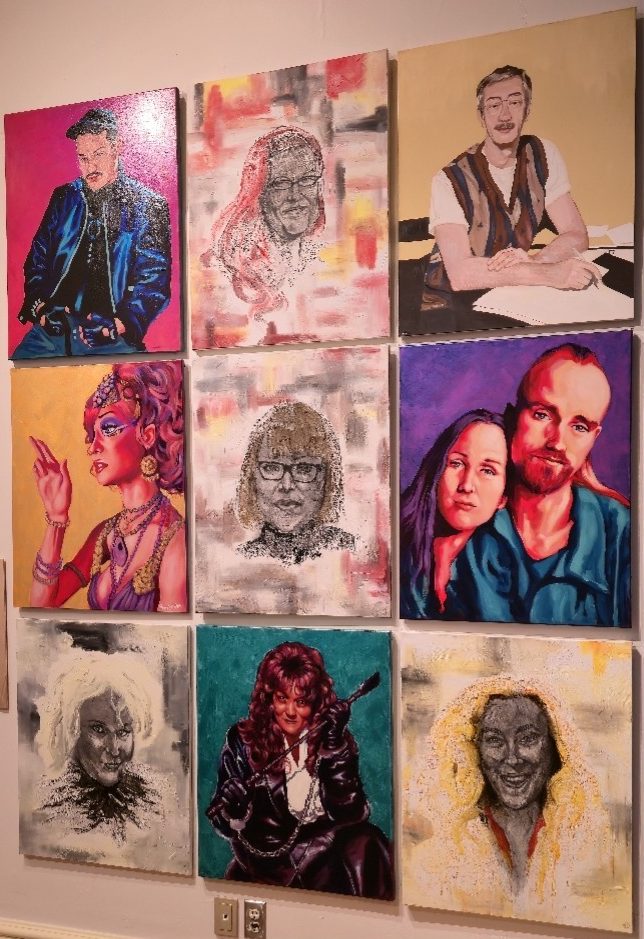
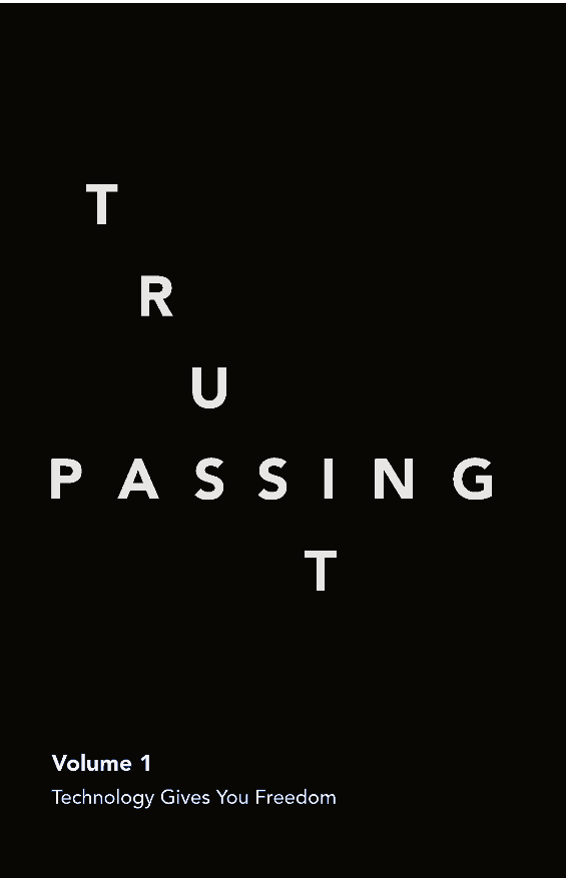
SWAP Hamilton’s visual art projects include the Sex Worker Portrait Series, the Sex Worker’s Film and Arts Festival, “Sex Workers Speak for Themselves,” and Trustpassing. In 2022, SWAP Hamilton commissioned five Hamilton-based artists to create portraits honoring important figures in sex-worker history, culture, and rights movements. Artist and former sex worker Robyn Lightwaker painted Gerald Hannon (journalist, gay liberation figure, and openly male sex worker), Nina Arsenault (trans multidisciplinary artist whose work links glamor, autobiography, and sex work experience), and Terri Jean Bedford (dominatrix and plaintiff a landmark Charter case that struck down three prostitution laws).
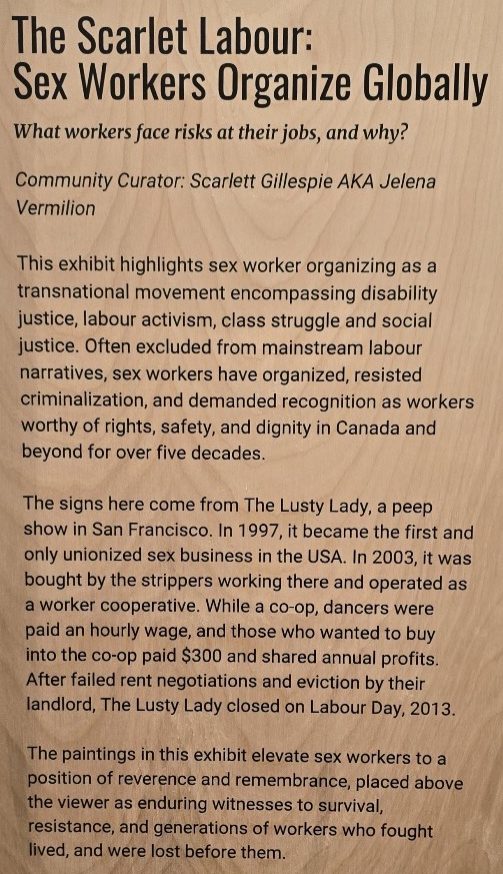
The series is a monument, not only to prominent activists who could be publicly named, but to the generations of sex workers whose lives and organizing have gone undocumented because stigma made visibility dangerous. It situates sex workers within portraiture and public memory as historical advocates worthy of commemoration. The paintings were originally displayed in SWAP Hamilton’s drop-in center, and nine of them are included in the Workers Arts & Heritage Centre’s long-term exhibition Work In Progress: Survival and Dignity, which reconsiders how labor history is presented and, importantly, who gets to tell it.
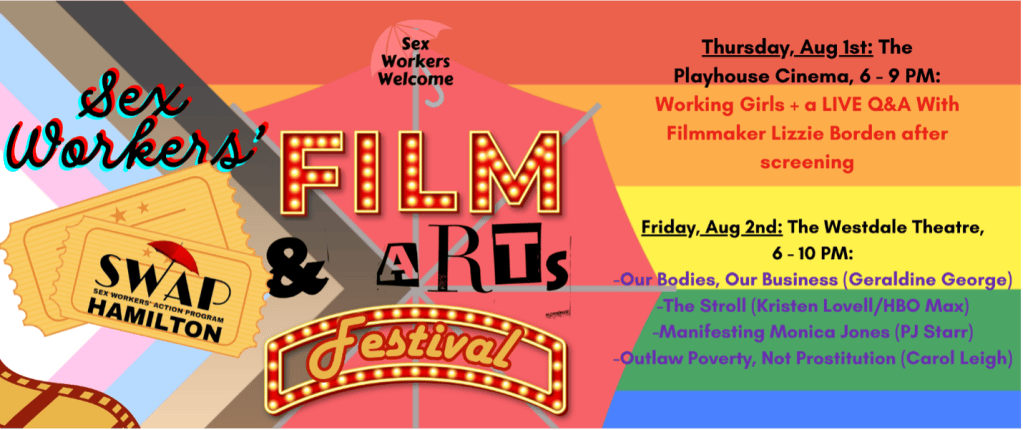
The San Francisco Bay Area Sex Worker Film and Arts Festival was founded by the late sex worker activist Carol Leigh in 1999 as a forum for sex worker film and video makers. Inspired by this festival, in August 2024 SWAP Hamilton organized the first Canadian Sex Workers’ Film and Arts Festival, which brought sex worker art and film into two mainstream Hamilton arts venues, the Playhouse Cinema and the Westdale Theatre. The festival treats film and art as tools for countering stigma, giving sex workers the ability to represent themselves rather than being represented almost exclusively through criminal, medical, or sensationalized narratives.
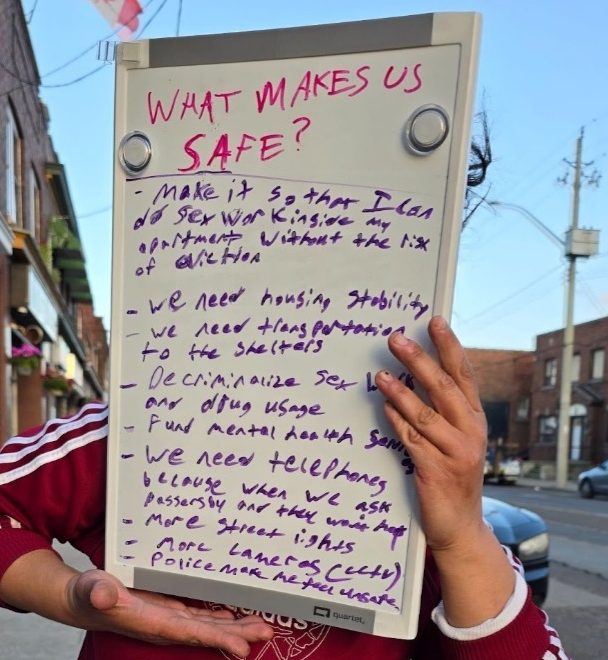
Also in 2024, SWAP Hamilton Executive Director Scarlett Gillespie (AKA Jelena Vermilion) and social worker Stephanie Milliken collaborated on the “Sex Workers Speak for Themselves” photovoice project. As part of the YMCA Hamilton’s gender-based safety audit, Vermilion and Milliken consulted with forty sex workers living outdoors in Hamilton to answer the question, “What makes us safe?” The project used photovoice methods, enabling participants to communicate experiences of safety, public space, and marginalization through photographic images and their own interpretation, rather than having researchers speak for them.
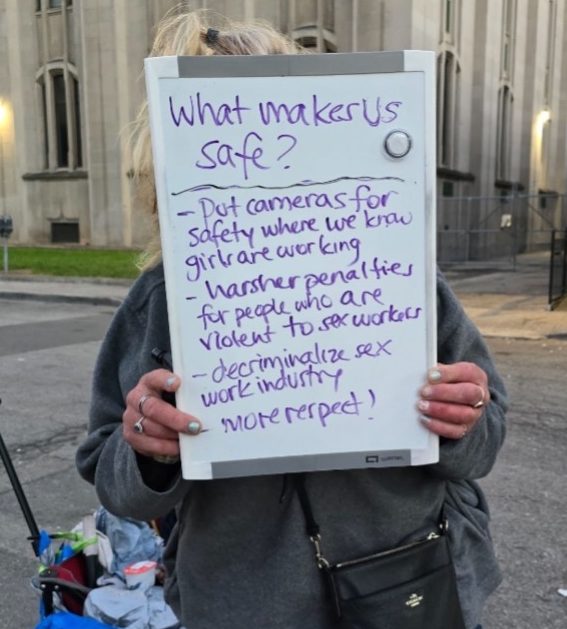
Sitting at the intersection of research and cultural production, photovoice becomes a means of documenting lived experience, producing knowledge and challenging institutional assumptions about what safety looks like.
Finally in 2025, SWAP Hamilton partnered with McMaster’s University Professor Andrea Zeffiro on Trustpassing, an arts-based participatory research project examining how digital insecurity intersects with housing, policing, employment, sex-work stigma, and material safety. Between January and May 2025, approximately 220 participants participated in creative workshops utilizing artistic practices such as collage and erasure/blackout poetry.
Those workshops were transformed into a four-volume zine series that remixed individual contributions into collective narratives. In this project, art was the research methodology. People who are normally treated as research “subjects” instead became knowledge-holders and cultural producers whose experiences could reshape dominant ideas about technology and safety.
SWAP Hamilton’s theater projects include Sex Worker Diaries…Spoken and Sung andVictoria Schneider: Verified.
Sex Worker Diaries…Spoken and Sung was a live musical production that ran for six performances at Performing Arts Lodges in Toronto in April 2026. The musical emerged from a participatory action research project that asked what sex workers would want non-sex workers to understand about the effects of stigma on their lives and work.
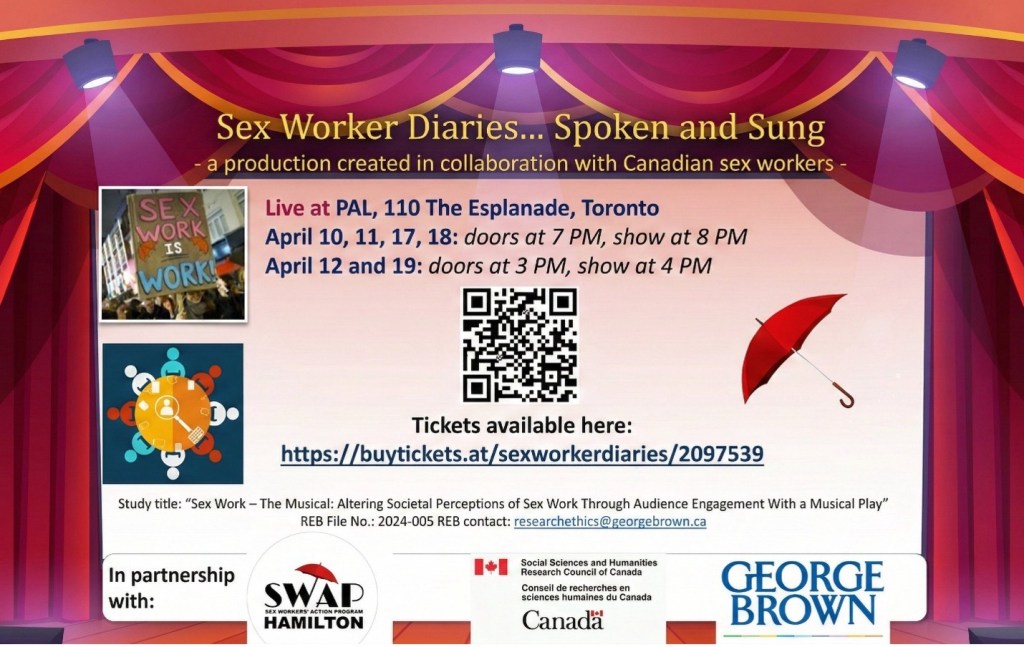
Fifty-two sex workers across Canada participated in interviews or focus groups, producing qualitative evidence about occupational health and safety, mental and physical health, relationships and the everyday consequences of stigma. These interviews and focus groups were analyzed and transformed into four original songs and four verbatim spoken-word pieces, turning community research into performance and public scholarship.
Rather than presenting audiences with an academic report, Sex Worker Diaries… Spoken and Sung used music, theatre and spoken word to challenge dominant stereotypes and invite audiences to engage emotionally and intellectually with sex workers’ lived realities. The project therefore sits directly at the intersection of arts practice, community-based research, and political education. It uses cultural production not merely to represent sex workers, but to center sex workers as knowledge-producers and narrators of their own lives. The trajectory from interviews to musical theatre also captures something central to SWAP Hamilton’s practice. Research is not simply extracted from community and returned as an academic paper. It can also circulate visual and performative forms, allowing sex workers’ own words to reach audiences who may never encounter them in a journal article.
More recently, SWAP Hamilton developed Victoria Schneider: Verified, a documentary theater work based on the true story of an American trans woman and sex worker who successfully challenged police abuse.
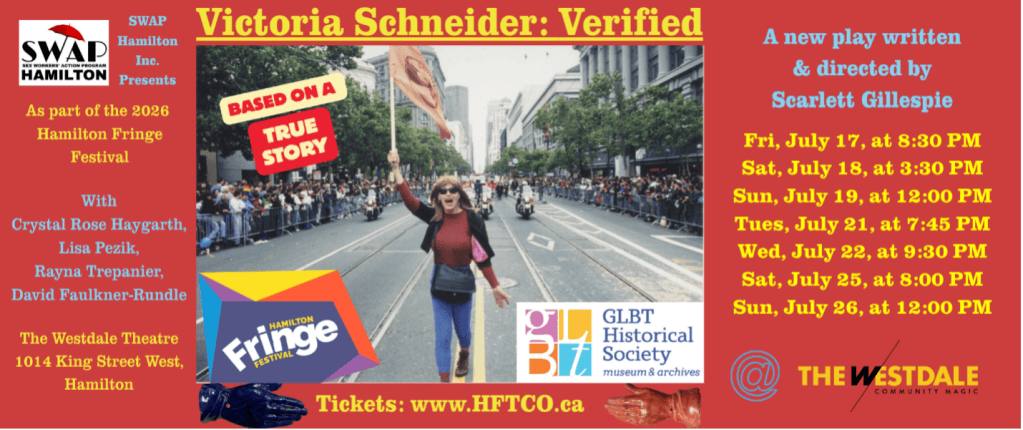
Victoria Schneider: Verified uses court transcripts and archival records, combining documentary theater, courtroom drama, and humor to examine institutional credibility, procedural power, and who is believed. It was developed with the direct involvement of Victoria Schneider and scheduled for the Hamilton Fringe Festival in 2026. Although the Fringe performances were ultimately cancelled due to technical issues at the venue, the project represents an expansion of SWAP Hamilton’s advocacy work into live theatre, using historical and legal records as source material for storytelling about sex worker and trans resistance. The play will be presented for the first time in 2027.
Altogether, the cultural production activities of SWAP Hamilton demonstrate that sex workers produce culture, knowledge, art, and history, though institutions often preserve representations of sex workers rather than work created by sex workers. A major part of SWAP Hamilton’s cultural work is therefore about shifting authorship and authority back toward sex workers themselves. Sex workers preserve their own history and create their own media in which lived experience is treated as cultural and intellectual knowledge.
Sex workers everywhere stand in solidarity with the victims & survivors of labor trafficking & exploitation. If you or someone you know is being forced to work against their will, you can contact the SWOP’s Community Support Line at 877-776-2004 or the Human Trafficking Hotline at 1-888-3737-888 for support.

